

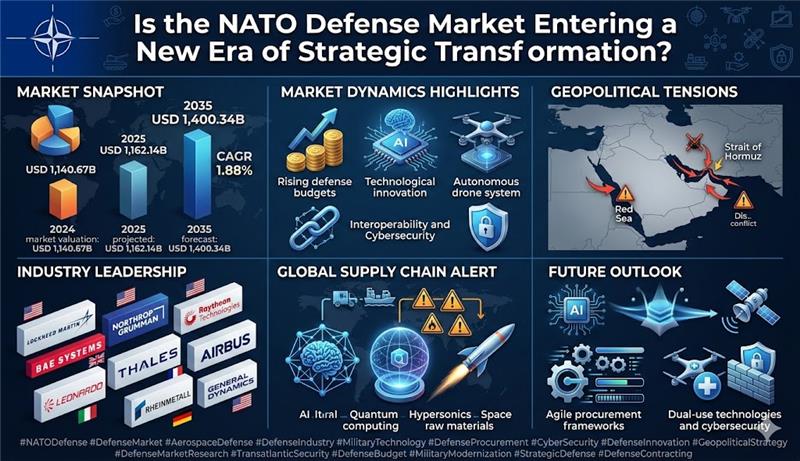
The NATO Defense Market is experiencing significant expansion as geopolitical uncertainties and modernization initiatives drive unprecedented investment across member nations. Valued at 1140.67 billion USD in 2024, the market demonstrated robust momentum by reaching 1162.14 billion USD in 2025, reflecting the alliance’s commitment to strengthening collective defense capabilities. Projections indicate sustained growth trajectory, with the market anticipated to achieve 1400.34 billion USD by 2035, advancing at a compound annual growth rate of 1.88% throughout the forecast period from 2025 to 2035. This steady expansion underscores NATO’s strategic priority to maintain technological superiority and operational readiness amid evolving global security challenges.
The competitive landscape features prominent defense contractors driving innovation and capability development across the alliance. Lockheed Martin leads with advanced fighter aircraft and missile defense systems, while Northrop Grumman specializes in autonomous systems and cyber warfare technologies. Raytheon Technologies provides cutting-edge radar and precision munitions, and BAE Systems delivers naval platforms and electronic warfare solutions. European champions including Thales Group, Airbus, Leonardo, and Rheinmetall contribute critical technologies ranging from satellite communications to armored vehicle systems. General Dynamics rounds out the key players with ground combat systems and command-and-control infrastructure, collectively forming an integrated defense industrial base supporting NATO’s strategic objectives.
Regional dynamics reveal distinct investment patterns and capability priorities across NATO territories. North America maintains the largest market share, driven by substantial United States defense expenditures exceeding 850 billion USD annually and Canada’s modernization programs focusing on Arctic sovereignty and NORAD cooperation. European markets demonstrate accelerated growth momentum, particularly following Russia’s aggression in Ukraine, with Germany increasing defense spending to meet the 2% GDP commitment, Poland investing heavily in armored divisions and air defense, and the United Kingdom advancing carrier strike group capabilities and next-generation fighter development.
Access Free Sample Copy – https://www.marketresearchfuture.com/sample_request/31698
The NATO Defense Market encompasses comprehensive segmentation across multiple dimensions. Defense Technology segments include artificial intelligence integration, hypersonic weapon systems, directed energy weapons, quantum computing applications, and space-based surveillance platforms. Operational Domain classification spans land forces modernization, naval fleet expansion, air superiority systems, cyber defense infrastructure, and strategic nuclear deterrence. Funding Source categories differentiate between national defense budgets, NATO common funding mechanisms, multinational collaborative programs, and public-private partnerships. Procurement Method analysis distinguishes direct government contracts, competitive bidding frameworks, foreign military sales, and licensed production agreements. Support Services extend beyond platforms to include maintenance and logistics, training and simulation systems, intelligence and reconnaissance support, and cybersecurity solutions.
Market segmentation reveals critical investment priorities reflecting contemporary threat environments. The cyber defense infrastructure segment exhibits the highest growth rate, addressing sophisticated state-sponsored attacks targeting critical military networks and command systems. Artificial intelligence integration transforms battlefield awareness through autonomous threat detection, predictive maintenance algorithms, and decision support systems. Space-based surveillance platforms enable persistent global monitoring capabilities, while hypersonic weapon systems development responds to peer competitor capabilities threatening NATO’s technological edge.
Several driving factors propel market expansion throughout the forecast period. Rising defense budgets across NATO members respond to Russian military aggression, Chinese assertiveness in the Indo-Pacific, and persistent terrorist threats requiring sustained counterterrorism capabilities. Technological obsolescence necessitates replacement of Cold War-era platforms with modern systems incorporating artificial intelligence, autonomous capabilities, and enhanced connectivity. Interoperability requirements drive standardization initiatives ensuring seamless coalition operations across diverse national forces. Supply chain resilience concerns following COVID-19 disruptions and geopolitical tensions accelerate efforts to establish redundant production capacity and secure critical material supplies within alliance territories.
Access Full Report – https://www.marketresearchfuture.com/reports/nato-defense-market-31698
Emerging trends reshape defense acquisition strategies and capability development pathways. Multi-domain integration merges land, sea, air, space, and cyber operations into unified command structures leveraging real-time data fusion and cross-domain targeting. Unmanned systems proliferation reduces personnel exposure while extending operational reach across contested environments. Directed energy weapons offer cost-effective solutions against drone swarms and precision munitions. Quantum technologies promise breakthrough capabilities in secure communications and computational power for complex battlefield simulations. Public-private partnerships accelerate innovation cycles by incorporating commercial sector agility into traditionally conservative defense procurement processes.
The escalating tensions involving Iran, Israel, and potential USA involvement significantly impact the NATO Defense Market by validating alliance readiness requirements and accelerating specific capability investments. The conflict demonstrates the effectiveness of layered air defense systems against ballistic and cruise missile threats, driving increased European demand for integrated air and missile defense architectures comparable to Israel’s Iron Dome and David’s Sling systems. Precision strike capabilities showcased throughout engagements reinforce NATO prioritization of long-range fires and standoff munitions development. The conflict’s cyber warfare dimension, including attacks on critical infrastructure and information operations, intensifies alliance focus on cyber defense investments and resilience programs. Should USA forces become directly engaged, the operational lessons would immediately inform NATO’s rapid response force structure, ammunition stockpile requirements, and expeditionary logistics capabilities essential for sustained coalition operations.
GLOBAL SUPPLY CHAIN & MARKET DISRUPTION ALERT
Escalating geopolitical tensions in the Middle East, particularly around the Strait of Hormuz and the Red Sea, are creating significant disruptions across global energy, chemicals, and logistics markets. Critical shipping corridors are under pressure, with major oil, LNG, petrochemical, and raw material flows at risk, triggering supply chain delays, freight cost surges, insurance withdrawals, and heightened price volatility. These disruptions are increasing operational risks and cost uncertainties for industries dependent on global trade routes and energy-linked feedstocks.
Frequently Asked Questions
Q1: How does NATO’s common funding mechanism support defense procurement among member nations?
NATO’s common funding allocates resources for shared infrastructure, command systems, and alliance-wide capabilities that no single nation would independently procure. This mechanism funds integrated air defense networks, secure communication systems, and joint training facilities, ensuring standardization and interoperability while reducing duplicative national expenditures on common requirements.
Q2: What role do small and medium enterprises play in NATO defense innovation ecosystems?
Small and medium enterprises increasingly contribute breakthrough technologies through flexible development processes and specialized expertise in emerging domains like artificial intelligence, cyber security, and quantum computing. NATO’s Defense Innovation Accelerator initiatives specifically engage these agile companies to complement traditional prime contractors, fostering competitive innovation that addresses capability gaps with cost-effective solutions.
Read Our Related Report:
Military Embedded Systems Market –
https://www.marketresearchfuture.com/reports/military-embedded-systems-market-9627
Cruise Missile Market –
https://www.marketresearchfuture.com/reports/cruise-missile-market-11914
Military Land Vehicles Market –
https://www.marketresearchfuture.com/reports/military-land-vehicles-market-16101
Drone Wind Turbine Blade Inspection Market –
https://www.marketresearchfuture.com/reports/drone-wind-turbine-blade-inspection-market-26065
Aerospace Avionic Market –
https://www.marketresearchfuture.com/reports/aerospace-avionic-market-29329